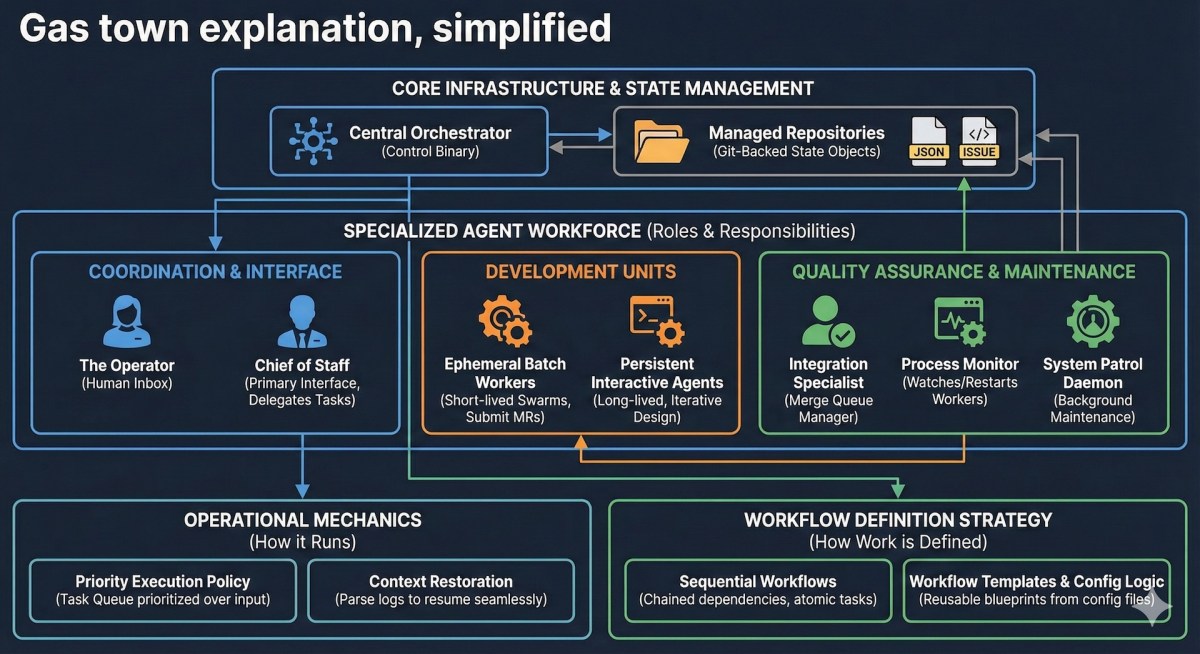
This blog post was co-authored with AI (Google Gemini).
Steve Yegge is back with “Welcome to Gas Town,” a novella-sized blog post about his new multi-agent coding systems, full of Mad Max references. It’s an entertaining but puzzling read. He describes a chaotic world of “polecats”, “GUPP”, and “Convoys”, covering the architecture with thick narrative lore.
To decipher what he is actually building, I fed the post and his GitHub repository into Gemini. It helped me understand Steve’s vision of a Kubernetes-like control plane for AI code agents and then helped write this blog post.
Decoding the Metaphors
Yegge’s system manages the chaos of running 20–30 concurrent AI agents in parallel in YOLO mode. Key parts:
- The Controller (“The Town”): A central Go binary that orchestrates agent lifecycles across projects.
- Git-Backed State (“Beads“): The atomic unit of work isn’t a database row; it’s a JSON file committed directly to the project’s Git history. This makes every task, status, and message persistent and version-controlled.
- The Interface: The system uses
tmuxas a dashboard (HUD) to manage the fleet of agents.
The Workforce
The “Gas Town” roles map to standard distributed system components:
- “Mayor” (Interface): A persistent agent acting as a Chief of Staff for the human user.
- “Polecats” (Batch Workers): Ephemeral agents spun up to execute tasks and vanish.
- “Refinery” (Merge Queue): An engineer agent that resolves merge conflicts when multiple workers submit code.
- “Witness” (Watchdog): A monitor that detects and restarts stalled agents.
Tackling complexity
More than the specific solution it’s interesting to see the underlying problems being solved for. Claude Code is polite and it stops to ask for confirmation, so, control systems are built to make it continue. Claude Code context compaction can remember the wrong things, so structured external memory is provided in specific and evolving ways. Etc.
The git repo reveals more of such complexity not fully explained in the blog, with the docs containing some of the more interesting insights of what happens when you do vibe coding at scale. For example, why identity of (sub)agents matters.
The repo’s AGENTS.md is interesting too. Agents are explicitly forbidden from asking permission to push; they must run tests, commit, push, and verify success before reporting back.
Looks like quite a serious attempt to build an industrialized coding factory, turning the developer from a coder into a manager of a synthetic manager of synthetic workers.
Looks like most of the work to make this happen is handling accidental complexity, not essential complexity. I wonder how much of that is due to building on top of Claude Code. Perhaps a future iteration integrates its own less-polite less-error-prone coding agent, something like pi?
(Yegge being co-author of the book Vibe Coding, who recently said in a talk “if you are using an IDE [in 2026], you are a bad engineer“, because you should use a coding agent)
 LeoSimons.com